The Street Art Before Spray Cans
Melbourne is Australia’s undisputed arts capital. Public art, performing art and numerous galleries, all do their bit to ensure there’s something pretty much everywhere to catch the eye and provoke the mind.
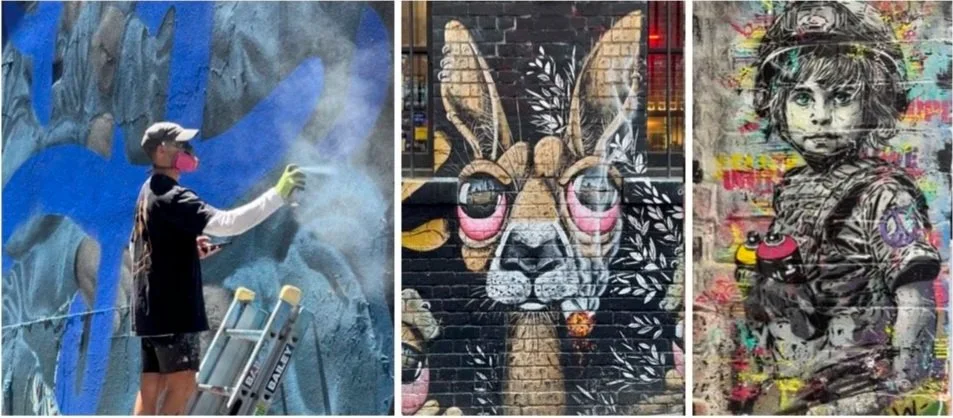
An artist at work and examples of street art in Melbourne’s laneways
Street art, over the last couple of decades, has grown to be a drawcard for many visitors to Melbourne. No need to seek out a gallery for this stuff, this is art that’s hard to avoid. Hosier Lane is the city’s most famous street art site, thanks in no small part to its convenient location, though many an artist will tell you there are better examples of the artform if you know where to look.
But large format pictures on vacant walls aren’t just a recent thing. “Anywhere near eye level we will not with patience tolerate large, flat blank spaces” declared a Melbourne newspaper in 1933, in an article gushing about a new mural unveiled in Collins Street.
The unnamed journalist then, almost prophetically, outlines his vision of the future of Melbourne’s outdoor art:
“Out of doors street decoration! It should give us great hope for the future. A few such decorations in our streets would alone suffice to make Melbourne famous; but one looks to the time when hundreds, thousands of them will be seen in the city, making it unique in the whole world; a place to visit for its building decoration alone.”
Wow. This guy was ahead of his time.
So, what was the artwork that so inspired this euphoric prediction of Melbourne’s decorated buildings? It was the Napier Waller mosaic, I’ll Put a Girdle Round About the Earth, which can still be seen today.
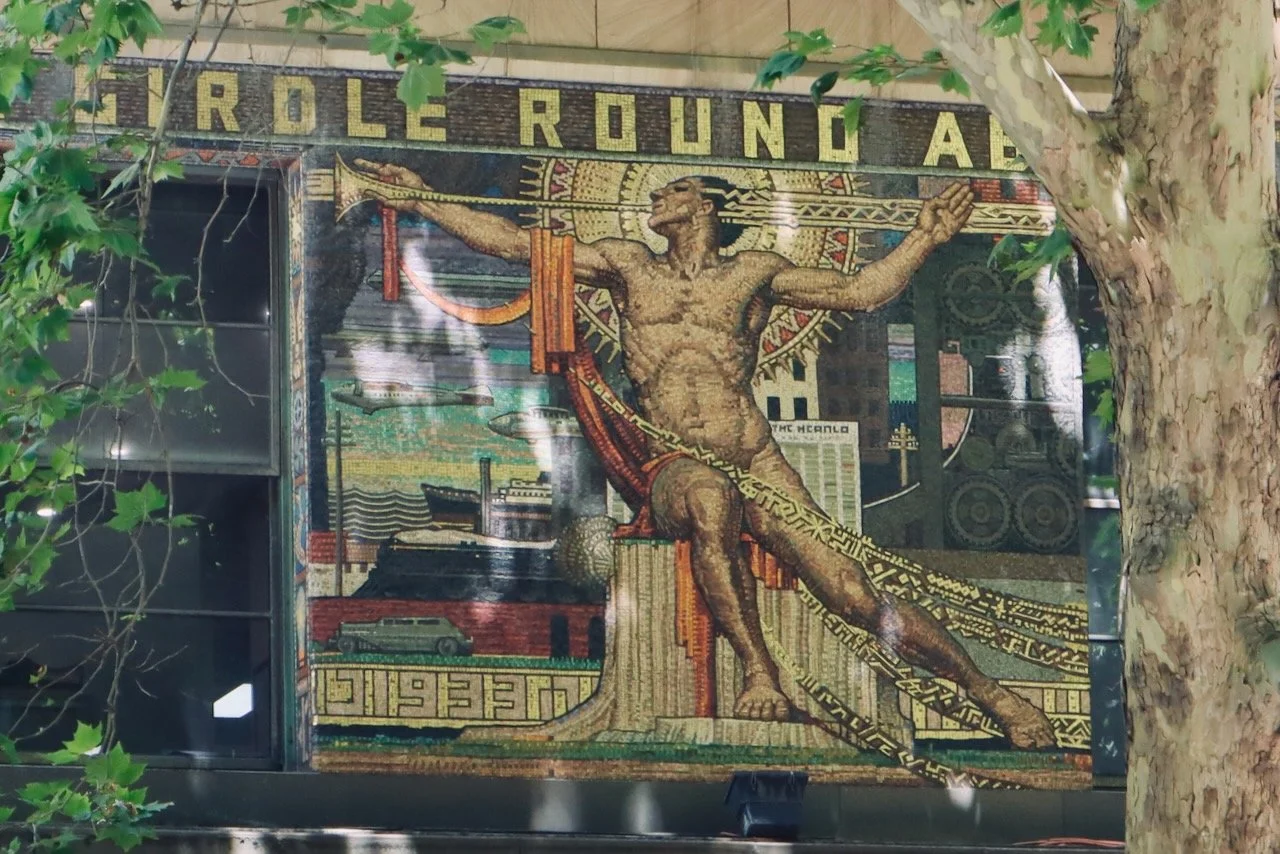
One of the three panels that make up Waller’s 1933 mosaic on Newspaper House, made from more than a quarter of a million glass tiles
Waller was a remarkable local painter, mosaicist, and stained-glass artist whose large format work adorns several buildings in Melbourne. Every day, thousands of people ascend the marble stairs of the State Library without glancing up to notice Waller’s 1929 mural, Peace After Victory. Or walk down Collins Street past the Versace store without turning their head to admire his not-so-snappily-titled, Better Than to Squander Life’s Gifts is to Conserve Them and Ensure a Fearless Future. What a shame.
Waller trained at the National Gallery School before heading off to serve in the First World War, which saw him seriously wounded resulting in the loss of his right arm. And he was right-handed.
Determined though that his disability would not overshadow his creativity, he set about teaching himself to paint with his left hand.
“Art isn’t a manual thing; it’s mental. If you have the ideas to express and the wish to express them, you will find the means.”
His artworks around Melbourne today – all of which were completed after the war – depict almost classical or mythological scenes, with larger-than-life figures always at the fore. It will surprise no one who has seen these figures to learn that Waller was awarded a special price for anatomy during his first year in college.
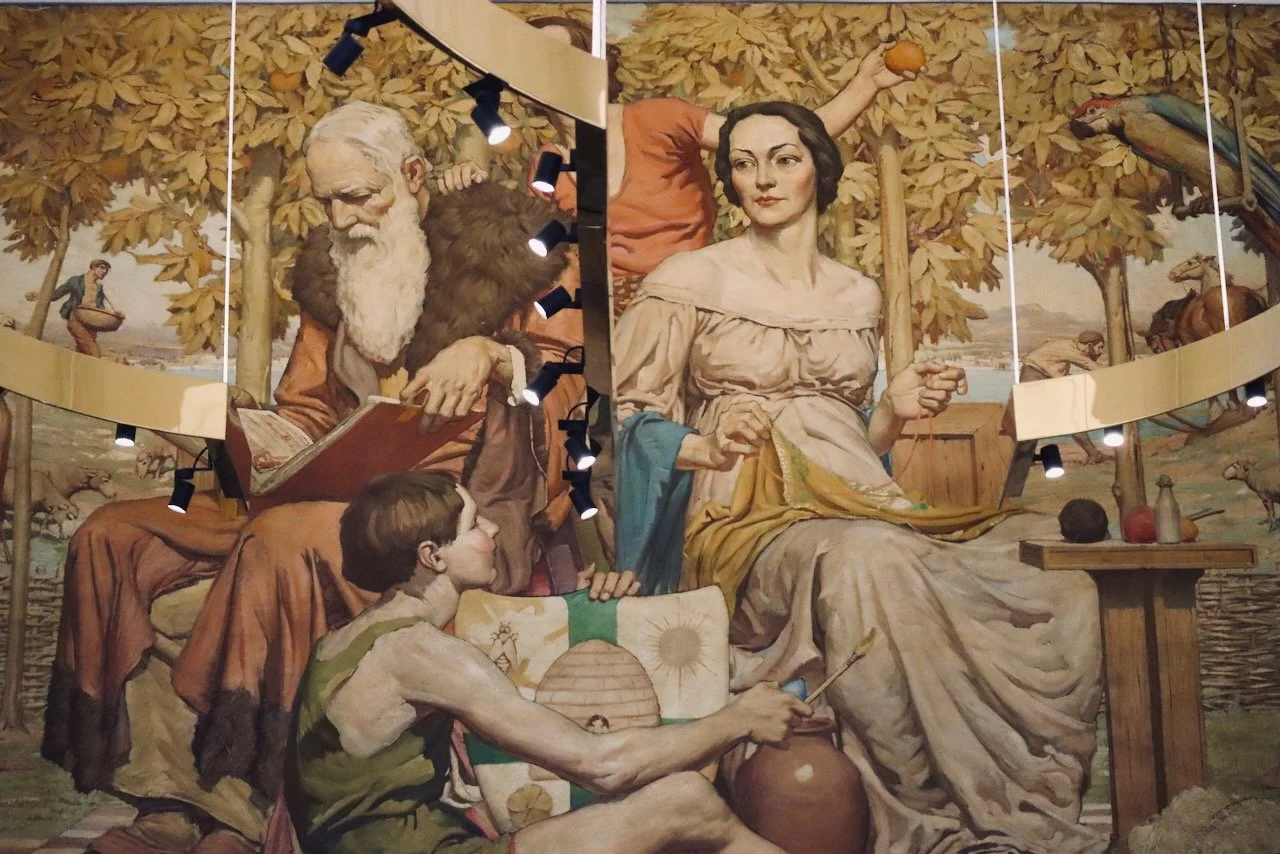
Partially obscured by hanging ceiling lights in the Versace store is this mural, painted in 1928
He was a master of materials too. In addition to his painted murals, several Melbourne churches feature Waller’s stained-glass windows, and the Town Hall is lined with more than 20 large panels, each made up of acoustic tiles carefully stained by Waller so as not to alter their sound dampening properties. And the mosaic that inspired the gushing remarks from the newspaper man all those years ago is made of glass tiles, some 270,000 of them.
Waller continued to work up until his death in 1972. The Hall of Memory at the Australian War Memorial in Canberra contains the largest collection of his work: a series of stained-glass windows and mosaics that took him and a team of assistants six years to complete.
Back in Melbourne, on the external wall of Newspaper House, is the 10 metre (33ft) long mosaic unveiled in 1933 with its title running full length along the top for all to see. The line might be borrowed from Shakespeare, but Putting a Girdle Round About the Earth has nothing to do with Puck doing his Superman best to circle the globe in 40 minutes. This is about media’s reach. Look carefully and you’ll see numerous references to newspapers, radio and communications.
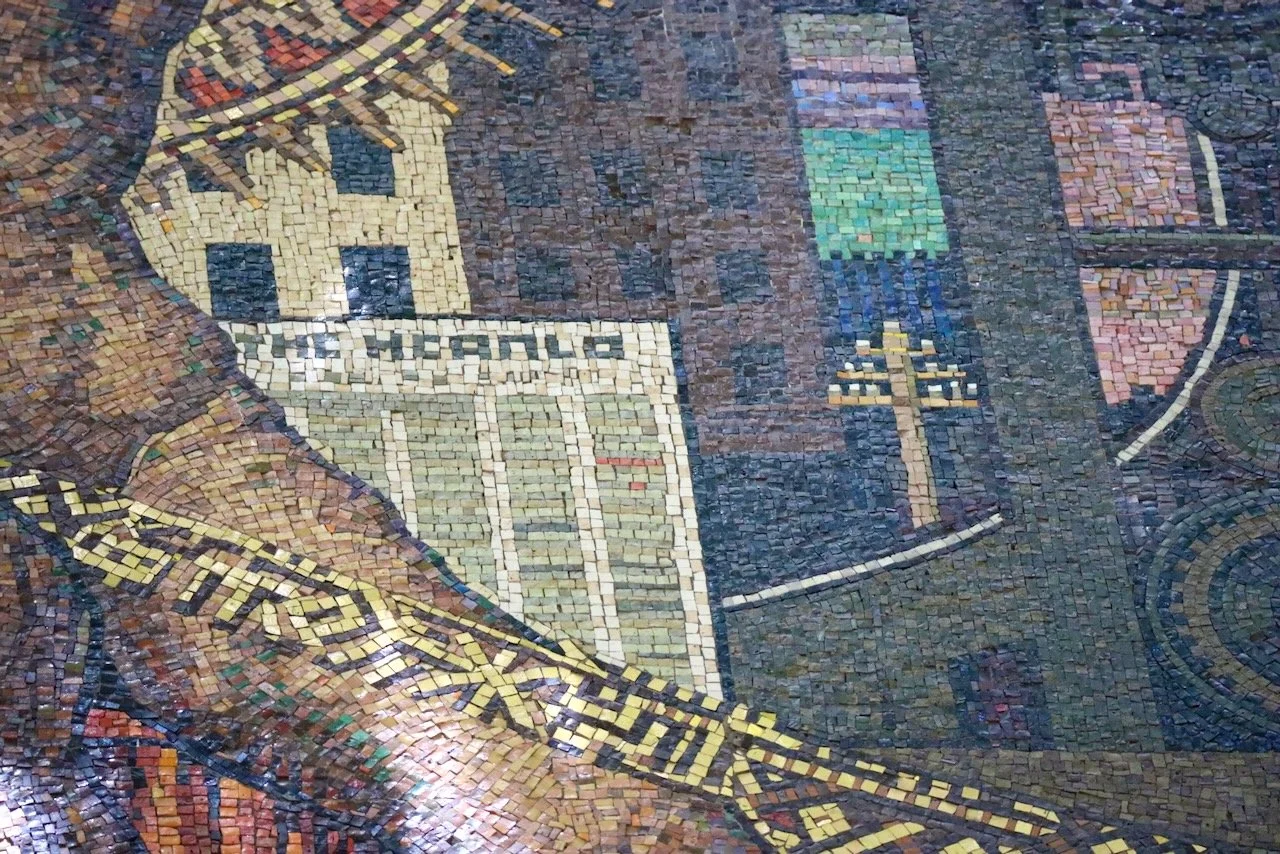
Detail of the Mosaic on Newspaper House
And who commissioned this celebration of media’s reach? One time newspaper owner, Sir Keith Murdoch. I wonder if even Sir Keith could have foreseen the extent of this reach achieved by his son Rupert, once he took over the family business.